From Black-and-White Classics to Streaming Originals: The Evolution of Christmas TV Specials
Few television traditions run as deep as the Christmas special. For more than sixty years, families have gathered around screens — first boxy black-and-white sets, then color televisions, and now smartphones and smart TVs — to watch stories built around the same season. But the format itself has changed dramatically. What began as a handful of carefully produced network broadcasts has expanded into a sprawling, year-round content category spanning dozens of platforms and hundreds of titles.
Understanding that journey means understanding something about American culture itself — how we watched, what we shared, and what we were willing to sit through commercials to see.
The Birth of a Holiday Tradition — Christmas TV in the 1960s
The modern Christmas TV special was essentially invented in the 1960s, when a small number of animated productions established the emotional and visual language the format still relies on today. Network television — CBS, NBC, and ABC — held near-total control over what audiences could watch, which meant a single broadcast could reach tens of millions of people simultaneously.
The stop-motion and hand-drawn animated specials that emerged during this decade weren't just entertainment; they were cultural events. Rudolph the Red-Nosed Reindeer, which debuted on NBC in 1964, demonstrated that a holiday special could become appointment television — something people planned their evenings around. A Charlie Brown Christmas followed on CBS in 1965 and proved that the format could carry genuine emotional weight, not just cheerful spectacle.
What made these early productions stick wasn't production budget. The animation was often simple by later standards. What worked was specificity of feeling — a particular blend of warmth, mild melancholy, and resolution that matched how many viewers actually experienced the holidays. These weren't sanitized celebrations; they acknowledged that Christmas could be complicated, lonely, or overwhelming, and then offered comfort anyway.
The scarcity of the broadcast model amplified everything. You watched when it aired, or you missed it until next year. That constraint created a shared cultural moment that no algorithm can fully replicate.
The Golden Age — How the 1970s and 1980s Defined the Classic Christmas Special
The 1970s and 1980s represent the peak of the network Christmas special as a cultural institution. During these decades, the format expanded beyond animation to include holiday variety shows, live performances, and celebrity-driven specials that drew massive ratings for the three major networks.
Annual broadcasts became rituals. Families knew which specials aired on which nights and built traditions around them. The emotional formula was well-established by this point: a problem or conflict introduced early, a journey toward understanding, and a resolution anchored in connection or generosity. It worked because it mapped onto how people wanted to feel during the season, not necessarily how they actually felt.
Network scheduling played a significant role in the format's dominance. Broadcasters treated December programming as prestige territory, investing in productions that could anchor an entire evening's ratings. A successful Christmas special wasn't just a one-time win — it could be rebroadcast annually for decades, becoming a reliable asset with almost no additional cost.
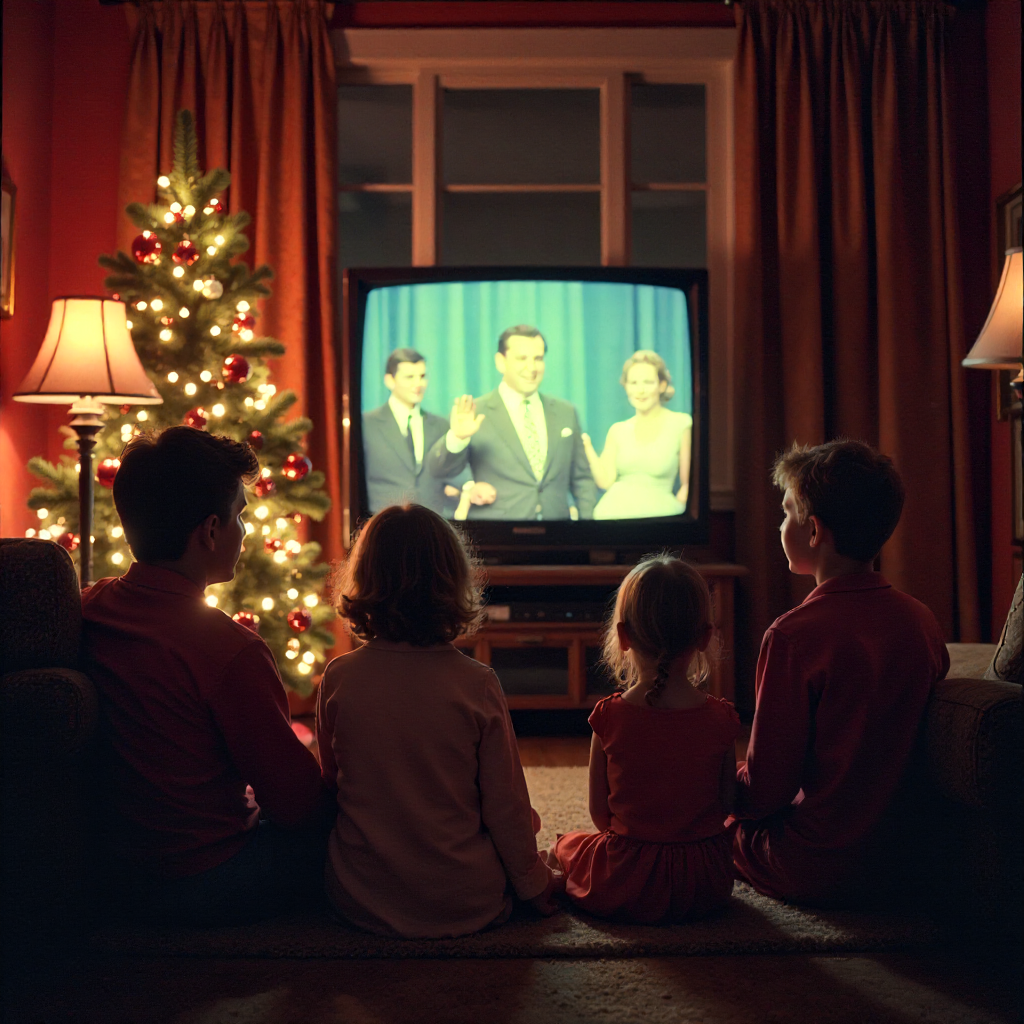
The variety show format, in particular, thrived during this era. Combining musical performances, comedy sketches, and celebrity appearances, these productions felt like a gift to the audience — a curated evening of entertainment that acknowledged the season without demanding too much emotional investment. They were designed to be watched with a full house, background noise and all.
Shifting Ground — The 1990s and the Rise of the Christmas TV Movie
The 1990s brought a structural shift: the Christmas TV special gradually gave way to the made-for-TV Christmas movie. Cable television's expansion gave audiences more choices, and channels like Hallmark began building dedicated holiday programming blocks that ran for weeks rather than a single night.
This transition changed the economics and the format simultaneously. A 90-minute Christmas film could fill a programming slot more efficiently than a 30-minute special, and it gave cable networks a way to compete with the big three broadcasters on their own terms. The stories grew longer, the romantic subplots more prominent, and the production values — while still modest — more cinematic.
The animated special didn't disappear, but it lost its position as the centerpiece of holiday television. Networks still aired the classic stop-motion productions from the 1960s, but original animated content became less common as costs rose and audience attention fragmented. Nostalgia became a programming strategy rather than an accident — broadcasters learned that audiences would reliably tune in for beloved titles they'd watched as children.
The 2000s — Nostalgia, Remakes, and the Fragmentation of Holiday Viewing
By the 2000s, the proliferation of cable channels had fundamentally altered the landscape of holiday TV. Appointment viewing was eroding. DVRs gave audiences the ability to time-shift programming, and early internet culture began circulating clips and commentary that changed how people related to seasonal content.
The response from networks and studios was largely nostalgic. Remakes, reboots, and CGI reimaginings of classic specials appeared with increasing frequency — an acknowledgment that the originals held cultural power that new productions struggled to match. Some of these updates succeeded on their own terms; many felt like they were borrowing equity rather than building it.
What the 2000s also produced was a kind of holiday content inflation. As more channels competed for December viewers, the sheer volume of Christmas programming expanded dramatically. The scarcity that had made the original specials feel significant was gone. Families could watch Christmas content every night of December without repeating a title — which sounds like abundance, but functioned more like dilution.
The Streaming Era — How Netflix, Disney+, and Others Reinvented the Christmas Special
Streaming platforms have done something genuinely interesting with the Christmas special format: they've invested in it heavily while simultaneously dismantling the conditions that made it culturally powerful in the first place. Netflix, Disney+, and Apple TV+ have all produced original holiday content with budgets that dwarf anything the network era attempted.
The results have occasionally been remarkable. Animated specials with theatrical-quality visuals, live-action holiday films with A-list casts, and even interactive specials that let viewers make narrative choices — the streaming era has expanded what the format can do technically. Disney+ in particular has leveraged its catalog of beloved characters and franchises to produce holiday content that connects to existing fan communities rather than starting from scratch.
But the on-demand model creates a paradox. Without a fixed broadcast date, there's no shared moment of viewing. A Netflix Christmas special might be watched by millions of people across a six-week window, each household on its own schedule. The communal dimension — the knowledge that your neighbors, your coworkers, your extended family were all watching the same thing at the same time — simply doesn't exist in the same way.
Global distribution is another significant change. Streaming platforms release holiday content simultaneously across dozens of countries, which means productions are increasingly designed to travel across cultures rather than speak specifically to one. That's a genuine gain in reach, but it sometimes comes at the cost of the particular, rooted quality that made the 1960s classics feel so specific and so true.
What's Been Lost and What's Been Gained
The honest accounting of sixty years of Christmas TV evolution involves losses and gains in roughly equal measure. What's been lost is primarily the shared broadcast moment — the experience of knowing that a significant portion of the country was watching exactly what you were watching, at exactly the same time. That scarcity created cultural weight that no amount of production budget can manufacture.
What's been gained is genuine diversity of form and story. The classic network special operated within a fairly narrow emotional and narrative range. Streaming-era holiday content includes darker comedies, stories centered on non-Christian winter traditions, LGBTQ+ holiday narratives, and international productions that bring entirely different cultural frameworks to the season. The format has become more inclusive, even if it's become less communal.
There's also the question of access. The original broadcast specials were available to anyone with a television and an antenna — which, in the United States, was nearly everyone. Streaming content requires a subscription, and often multiple subscriptions to access the full range of holiday programming. The economics of abundance have introduced a new kind of inequality into seasonal viewing.
The Enduring Appeal — Why Christmas Specials Still Matter
Despite every structural change in how television is produced and consumed, Christmas specials continue to be made, watched, and remembered. The format has survived the transition from three networks to five hundred channels to infinite streaming libraries — which suggests it's meeting a need that goes deeper than any particular delivery mechanism.
That need is probably simpler than the industry analysis makes it sound. Christmas specials offer a reliable emotional experience at a time of year when people are actively seeking one. They're not primarily about plot or character in the way a drama series is; they're about feeling something specific — warmth, generosity, the particular sweetness of a season that's almost over. The story is almost secondary to the mood it creates.
The classics from the 1960s still air because they do this efficiently and without pretension. The best streaming-era productions succeed for the same reason, regardless of their budget or platform. The format endures because the emotional function it serves doesn't change, even as everything around it does.
What audiences keep returning for, season after season, is less about any specific title and more about the ritual of watching itself — the act of sitting down with people you care about and agreeing, for an hour or two, to feel something together. That's a remarkably durable thing to build a television format around.
Frequently Asked Questions
What was the first Christmas TV special ever broadcast?
Early Christmas television content appeared in the late 1940s and early 1950s as the medium itself was developing. However, the format as most people recognize it — a standalone, narrative holiday special designed as a cultural event — took shape in the early 1960s with the emergence of animated productions on the major networks.
Why did animated Christmas specials become so popular in the 1960s?
Animation allowed producers to create visually distinctive holiday worlds at a manageable cost, and the hand-drawn or stop-motion aesthetic gave these specials a timeless quality that live-action productions couldn't match. They also worked across age groups, which made them valuable to networks trying to reach the entire family with a single broadcast.
How have streaming platforms changed the way families watch Christmas content?
Streaming platforms have shifted holiday viewing from a shared, scheduled event to an on-demand experience. Families can now watch Christmas content at any time across a much wider range of titles, but the communal dimension of everyone watching simultaneously has largely disappeared. The trade-off is between abundance and the sense of shared occasion.
Are traditional network Christmas specials still being made today?
Yes, though in smaller numbers and with less cultural centrality than in the broadcast era's peak. The major networks still produce and air holiday specials, and the classic animated titles from the 1960s continue to be broadcast annually. However, the creative and financial energy in holiday TV production has shifted significantly toward streaming platforms.
What makes a Christmas TV special become a long-lasting classic?
The specials that endure tend to combine a specific emotional truth about the season with a visual or musical identity that's genuinely distinctive. They don't try to be universally appealing in a way that flattens them into blandness — they're specific enough to feel real, and that specificity is what makes them resonate across generations. Production quality matters far less than emotional honesty.